
Does FCC Part 15.407 have a conducted spurious emission requirement?
Conclusion first: FCC Part 15.407 has no conducted spurious emission requirement.
The following provides a professional analysis from three aspects: the technical provisions of the regulation, the test methods, and the background of the industry's misinterpretation.
Analysis of the regulatory technical provisions
Refer to 47 CFR 15.407(b):
(b) Undesirable emission limits. Except as shown in paragraph (b)(10) of this section, the maximum emissions outside of the frequency bands of operation shall be attenuated in accordance with the following limits:
(1) For transmitters operating in the 5.15-5.25 GHz band: All emissions outside of the 5.15-5.35 GHz band shall not exceed an e.i.r.p. of −27 dBm/MHz.
(2) For transmitters operating in the 5.25-5.35 GHz band: All emissions outside of the 5.15-5.35 GHz band shall not exceed an e.i.r.p. of −27 dBm/MHz.
(3) For transmitters operating in the 5.47-5.725 GHz band: All emissions outside of the 5.47-5.725 GHz band shall not exceed an e.i.r.p. of −27 dBm/MHz.
......
- Nature of the limits:
The provision explicitly requires out-of-band emissions to meet an e.i.r.p. (Equivalent Isotropically Radiated Power) limit (e.g., −27 dBm/MHz), rather than a conducted power limit.
- Direction of the test method:
The regulation does not require conducted spurious emissions to be measured directly from the RF port; instead, compliance is evaluated through radiated measurements. This requirement complements the radiated limits of FCC Part 15.205 for restricted bands (peak 74 dBµV/m, average 54 dBµV/m), but both fall within the radiated category.
Basis for the compliance of the test method
ANSI C63.10 standard:
As described in Section 12.7.4.2 of that standard, antenna port conducted measurements are permitted as an alternative method for radiated spurious emission measurement, but the antenna gain and related factors must be compensated through conversion to emulate the radiated field strength. This method is merely an equivalent alternative to the radiated test, not an independent requirement for conducted spurious emissions.
Terminology distinction:
- Conducted Spurious Emissions: Directly measures the spurious emissions at the RF port; the limits are based on port power (e.g., dBm).
- Conducted Method for Radiated Spurious Emissions: Derives the radiated field strength through port measurement, and needs to be converted to e.i.r.p. Part 15.407 only involves the latter case, and its essence is still radiated compliance verification.

A digression
Why do many people now mistakenly believe that 15.407 has a conducted spurious emission requirement? This may be a long story. The beginning of the story can be traced back to a document released by the TCBC in 2022.
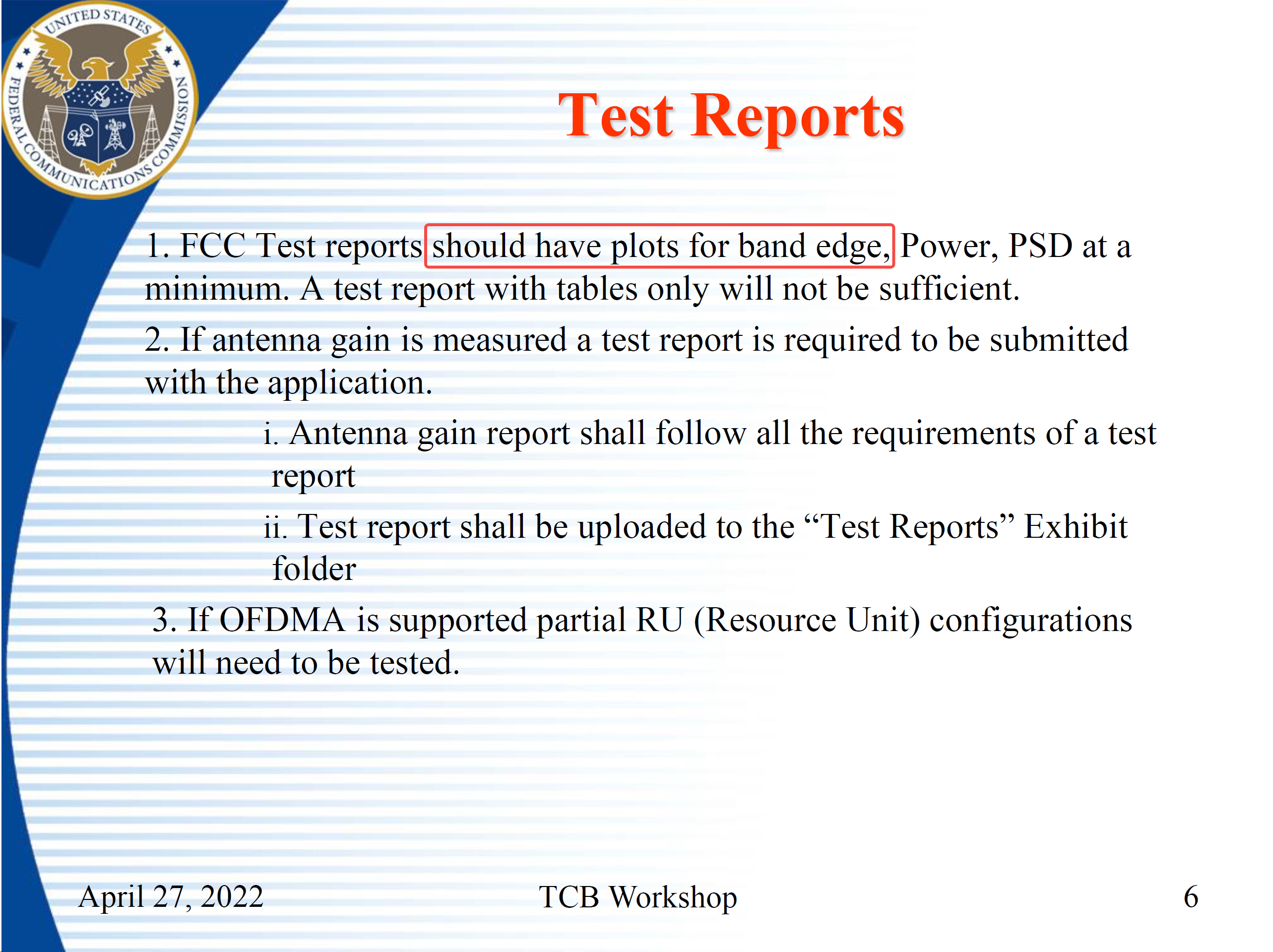
The release of this document forced TCBs to require laboratories to provide band edge test plots. However, testing with the radiated method would undoubtedly put great pressure on laboratories, so TCBs came up with a workaround: accept a band edge plot measured with the conducted method and turn a blind eye.
The TCB's original intention was probably to have laboratories refer to ANSI C63.10 Section 12.7.4.2 and use the currently acceptable conducted method as an alternative for performing the radiated spurious emission test. But over time, this was gradually misconstrued as a conducted spurious emission requirement.