
Creating a Test Plan - MIC 5G
The MIC 5G option is used for Japan MIC (総務省) technical conformity certification testing of RLAN products in the 5 GHz band. When creating a test plan, select the Type (technology) first: RLAN / Proprietary. Each type is described separately below.
RLAN
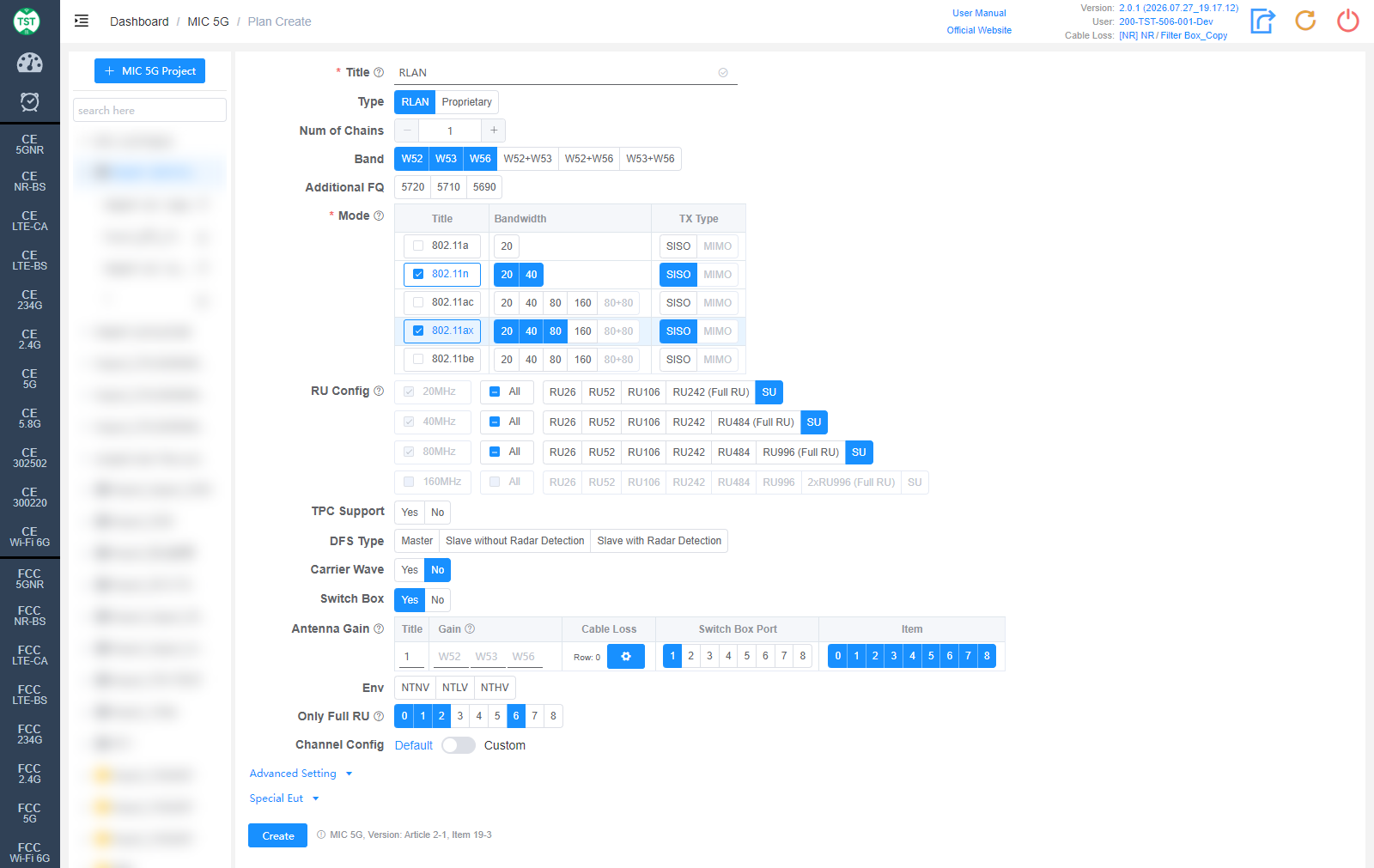
Title: Test plan name, entered by the user, e.g., RLAN / WiFi-5G.
Type: Technical category, select RLAN here.
Num of Chains: Number of transmit chains (antennas) the product has.
Band: Operating bands supported by the product, multi-select: W52 (5150 ~ 5250 MHz) / W53 (5250 ~ 5350 MHz) / W56 (5470 ~ 5725 MHz). If the product supports the 80M + 80M bandwidth configuration, band combinations such as W52+W53 / W52+W56 / W53+W56 also need to be selected.
Additional FQ: In the 2020 MIC version update, the three frequencies 5720 / 5710 / 5690 were opened up; if the product supports these three frequencies, they need to be additionally selected. This option appears only after W56 is checked.
Mode: Modes supported by the product (required): 802.11a / n / ac / ax / be. After checking a mode, select the corresponding Bandwidth (20 / 40 / 80 / 160 / 80+80 MHz) and TX Type (SISO / MIMO).
RU Config: RU (Resource Unit) configurations supported by 802.11ax / be devices. The Full RU of each bandwidth is required; select the other RU configurations according to the product's actual support. Displayed after 802.11ax / be is checked.
TPC Support: Confirm whether the product supports TPC (Transmit Power Control). This option affects the Power Limit. Displayed after W53 / W56 is selected.
DFS Type: DFS type of the product: Master (actively listening device) / Slave without Radar Detection, etc. Displayed after W53 / W56 is selected.
Carrier Wave: Whether the product supports carrier wave transmission. If Yes is selected, the frequency error will be measured in carrier wave mode; the test setup differs considerably from the modulated signal test.
Switch Box: Whether to use a Switch Box. If a Switch Box has not been purchased, select No, and the product will be directly connected to the spectrum analyzer for testing.
Antenna Gain:
Title: Antenna number, named sequentially by default as 1, 2, 3, 4..., or manually input other names according to customer requirements.
Gain: Gain of each antenna in the corresponding band (Band).
Cable Loss: Cable loss of the RF cable from the product's antenna port to the Switch Box (RF port of the switch) or the SA (spectrum analyzer). How to Create Common Cable Loss.
Switch Box Port: Port number of the switch connected to the product's antenna.
Item: Test items for each antenna; the numbers correspond as follows:
(M5000) Duty Cycle
(M5001) Frequency Error (周波数の許容偏差)
(M5002) Occupied Bandwidth (占有周波数帯幅)
(M5003) Antenna Power (空中線電力)
(M5004) Adjacent Channel Leakage Power
(M5005) Out Of Bands Leakage Power
(M5006) Transmission Burst Length
(M5007) Spurious Emission Intensity
(M5008) Secondary Radiated Emission
The software preselects the default test items according to the technical characteristics. Note: In some cases, test parameters are mutually referenced between items; it is recommended to create the test plan with the default items.
Proprietary
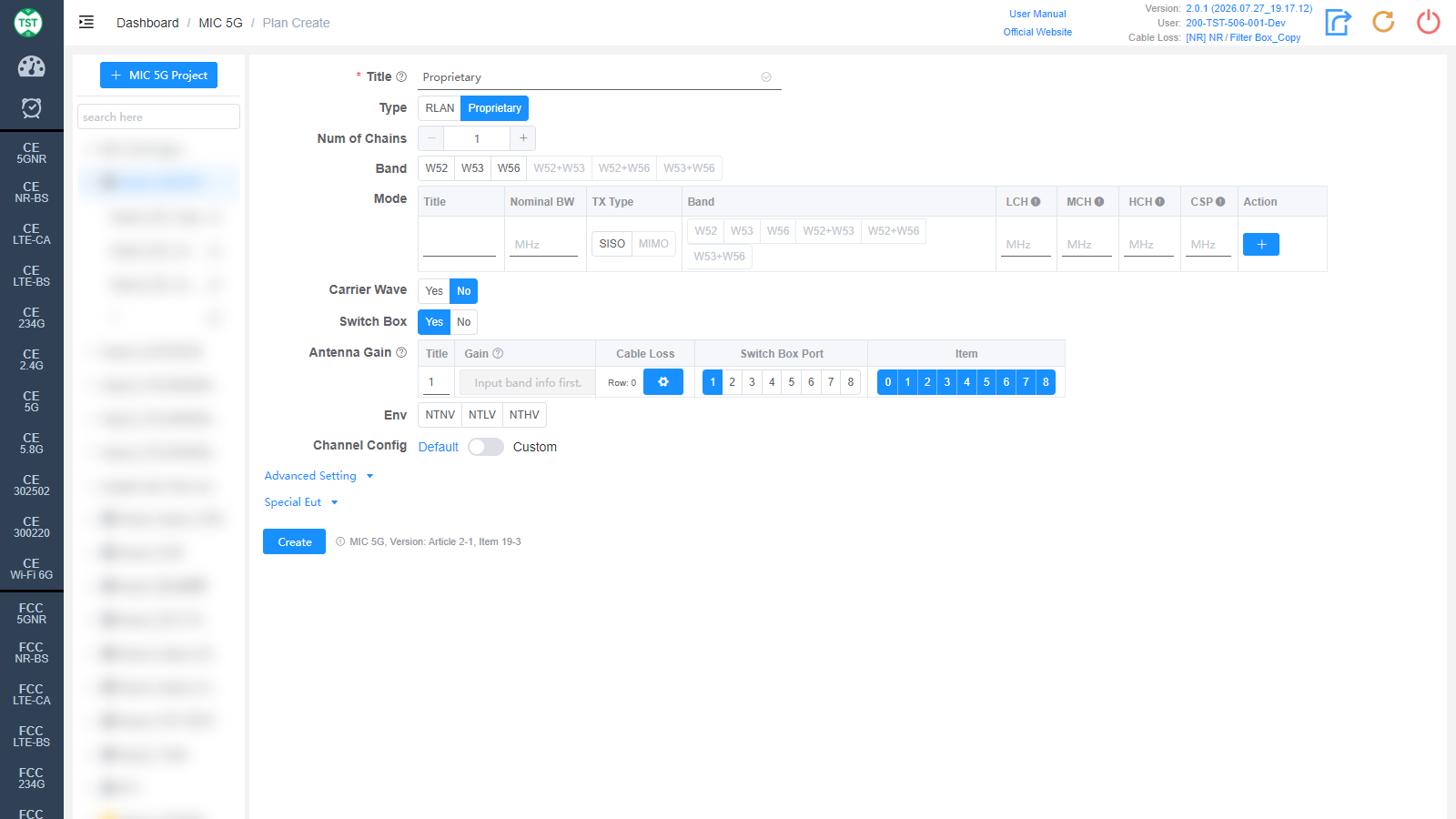
Type: Technical category, Proprietary (custom product).
Band: Same as RLAN.
Mode: Custom mode table:
Title: Mode number; other names can be manually input according to customer requirements.
Nominal BW: Sets the nominal bandwidth occupied by the signal on the spectrum.
TX Type: Transmission type, SISO / MIMO.
LCH / MCH / HCH: Low / middle / high channel frequency settings (MHz).
CSP: Channel Spacing.
Action: Used to add / delete mode configuration rows.
Carrier Wave / Switch Box / Antenna Gain are the same as RLAN and are not repeated here.
Advanced Setting and Special Eut Settings
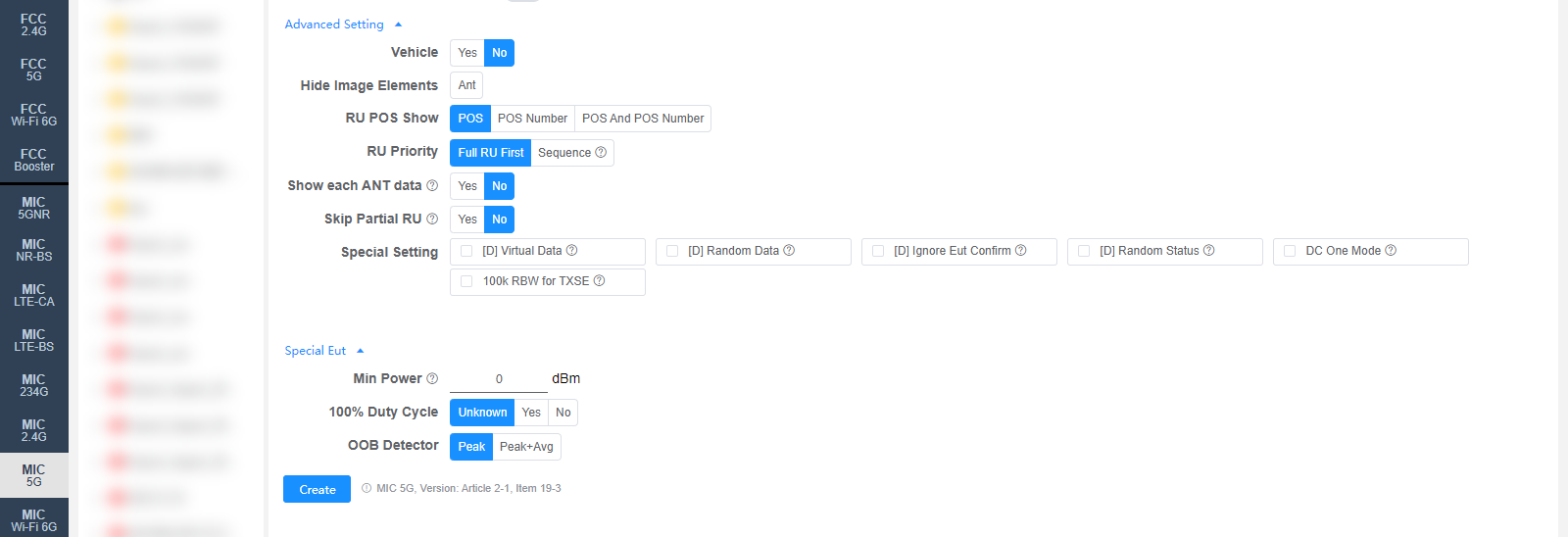
The following settings can generally be kept at their default values. Adjust them only when the test results are abnormal or there are special test requirements.
Env: Environmental conditions to test, multi-select: NTNV / NTLV / NTHV (normal / low / high voltage at normal temperature).
Channel Config: Channel configuration, Default or Custom (manually customized channels).
Vehicle: Confirm whether the product is a vehicle-mounted product, default No.
Hide Image Elements: Select the elements to hide in report images (e.g., the Ant antenna marker).
RU POS Show: How the RU position is displayed in the report: POS / POS Number / POS And POS Number.
RU Priority: RU test priority: Full RU First or Sequence (in the order RU26 → RU52 → RU106...).
Show each ANT data: Whether to display the data of each antenna for MIMO. Used for spurious emissions and out-of-band emissions.
Special Setting: Special settings. Options prefixed with [D] are debug options and do not need to be checked for normal testing:
[D] Virtual Data / [D] Random Data / [D] Ignore Eut Confirm / [D] Random Status: Debug options.
DC One Mode: Only one duty cycle is tested per mode.
100k RBW for TXSE: Transmitter spurious emissions (30 MHz ~ 1000 MHz) use 100 kHz RBW. Modifying this option requires a retest to take effect.
Min Power: Sets the minimum power (dBm); 0 means automatic.
100% Duty Cycle: Whether the sample's duty cycle is 100% (Unknown / Yes / No); only needs to be selected when the system misjudges the duty cycle.
OOB Detector: Detector for out-of-band measurements: Peak / Peak+Avg.
Corresponding software option: MIC 5G